The 10 Best Study Techniques That Actually Work
Most students study the way nobody ever told them not to: rereading notes and highlighting until the page glows. It feels productive, but the research says it mostly isn't. Here are the ten techniques with the best evidence behind them, how to try each one tonight, and three popular habits worth dropping.
In 2013, five psychologists led by John Dunlosky went through the research on ten techniques students use all the time and rated each one on how much it actually helps. Only two earned their top rating. Two of the most popular, rereading and highlighting, landed near the bottom.
This list starts from that review and adds what later studies and experienced teachers have found since. It's ordered by how much difference each technique is likely to make for a typical student preparing for exams. For each one you'll find what it is, why it works, and a way to try it in your next session.
If you only change two habits, make them these: test yourself instead of rereading, and spread your revision across days instead of cramming it into one. They're the two techniques with the strongest evidence behind them, and they work in almost every subject.
The list at a glance
| # | Technique | Best for | Evidence |
|---|---|---|---|
| 1 | Active recall | Almost everything | Strong |
| 2 | Spaced repetition | Facts, formulas, vocabulary | Strong |
| 3 | Timed past papers | Exam technique and timing | Strong (a form of practice testing) |
| 4 | Interleaving | Maths, physics, any problem-solving | Moderate, and strong in maths |
| 5 | Asking why | Concepts and theory | Moderate |
| 6 | Explaining it (the Feynman technique) | Topics you think you understand | Moderate |
| 7 | Concrete examples | Abstract ideas | Good, from memory research |
| 8 | Dual coding | Processes, systems, timelines | Good, from memory research |
| 9 | Planning and reviewing your study | Long preparation | Strong in school research |
| 10 | Timed focus blocks | Starting and staying focused | Mixed |
The evidence column is our own summary of the sources listed at the end. "Strong" means a technique has helped students across many studies, ages and subjects. "Moderate" means the results are promising but come from fewer or narrower studies.
1. Active recall (testing yourself)
Active recall means closing the book and pulling the information out of your own head: answering questions, working through flashcards, or writing down everything you remember about a topic. It's also called retrieval practice, and it's the closest thing study research has to a sure bet.
The best-known experiment is simple. In 2006, Henry Roediger and Jeffrey Karpicke gave students short passages to learn. Some read them again and again. Others read them and then practised recalling them. On a test five minutes later, the rereaders did slightly better. On tests two days and a week later, the students who had practised recalling remembered far more. Dunlosky's review made practice testing one of only two techniques to get its top rating.
Recall feels slower and harder than rereading, and that's the point. The effort of dragging something back out of memory is what makes it stick.
Try it tonight:
- Blurting. After you study a section, close your notes and write down everything you can remember on a blank page. Then open the book and fill in what you missed in a different colour. The gaps are tomorrow's revision.
- Turn headings into questions. "Photosynthesis: light reactions" becomes "What happens in the light reactions, and where?" Answer out loud before you look.
- Say the answer before you flip a flashcard. Recognising an answer when you see it isn't the same as being able to produce it in an exam hall.
2. Spaced repetition
Spaced repetition means reviewing the same material several times over days and weeks, instead of in one long block. You forget fast at first, and each review just as a memory starts to fade makes it last longer the next time. Dunlosky's team gave spaced practice their other top rating, because it helped learners of different ages and abilities across a wide range of material.
Cramming works for tomorrow's test. Spacing works for the exam in three months, which is usually the one that matters.
Try it tonight:
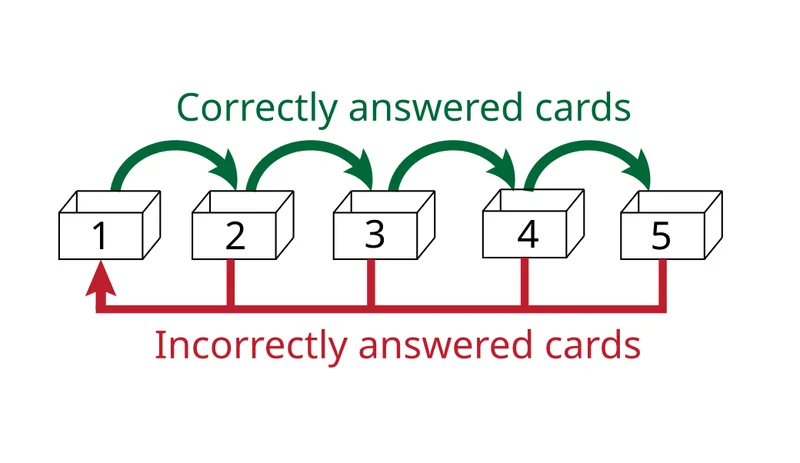
- Use the Leitner system. Sort your flashcards into five boxes. Review box 1 every day, box 2 every few days, box 3 once a week, and so on. A right answer moves a card up a box. A wrong one sends it back to box 1.
- Let an app do the scheduling. Flashcard apps like Anki work out when each card is due, so you mostly see the ones you're about to forget.
- Put review dates in your calendar on the day you first learn a topic: the next day, a few days later, a week later, and again close to the exam.
3. Past papers under timed conditions
A past paper is active recall in the exact shape of your exam. You practise remembering the content, and you also practise reading questions quickly, managing the clock and keeping going when you're stuck. None of that comes from reading notes.
Try it tonight:
- Sit a paper in one go, timed, with your phone in another room. If a full paper is too long for tonight, do one section under its real time limit.
- Mark it honestly against the official answer key or mark scheme, not your memory of what you meant.
- Keep an error log. Write down every mistake and why it happened: you didn't know it, you misread it, or you ran out of time. Redo those questions a week later.
How many papers you need depends on your exam. Our guides to JEE, NEET and SAT study hours cover how mock tests fit into a full plan.
4. Interleaving (mixing problem types)
Most textbooks give you twenty problems on the chapter you just finished. Interleaving means mixing different kinds of problems in one session, so you have to work out which method each question needs before you can solve it. That choice is exactly what an exam asks of you, and it's the part that blocked practice skips.
The evidence is strongest in maths. In a 2007 experiment by Doug Rohrer and Kelli Taylor, students who practised mixed problems did worse during practice but far better on a test a week later. In a later classroom study, seventh-graders who got interleaved maths homework for three months scored clearly higher on a surprise test a month after it ended.
Try it tonight:
- Add old questions to new sets. When you finish a chapter, mix a few problems from earlier chapters into every practice set.
- Shuffle your flashcards across topics instead of going through them one chapter at a time.
- Mix things that are easy to confuse. Interleaving helps most when problem types look alike, such as different integration methods or different kinds of motion questions. Mixing completely unrelated subjects doesn't do much.
5. Asking why (elaboration)
Elaboration means asking yourself why something is true and how it connects to what you already know. The question-asking version is called elaborative interrogation, and Dunlosky's review rated it moderately useful. A fact linked to other facts has more ways back into your memory than a fact sitting on its own.
Try it tonight: for each point on a revision list, add one line that starts with "because". Why does raising the temperature speed up a reaction? Why did the policy fail? Why does this step come before that one? If you can't write the line, you've found something you memorised without understanding.
6. Explaining it (the Feynman technique)
Explaining a topic in your own words is one of the fastest ways to find out whether you understand it. Researchers call it self-explanation, and it got the same moderate rating as elaboration. Students usually know it as the Feynman technique, after the physicist Richard Feynman, who was famous for explaining hard ideas simply. The four-step version is a modern summary of his approach rather than something he wrote down, but it works:
- Pick one concept and write its name at the top of a blank page.
- Explain it in plain language, as if to a friend two years younger than you.
- Notice where you get stuck, wave your hands or fall back on jargon. Those are your gaps.
- Go back to your notes for just those gaps, then explain it again, more simply.
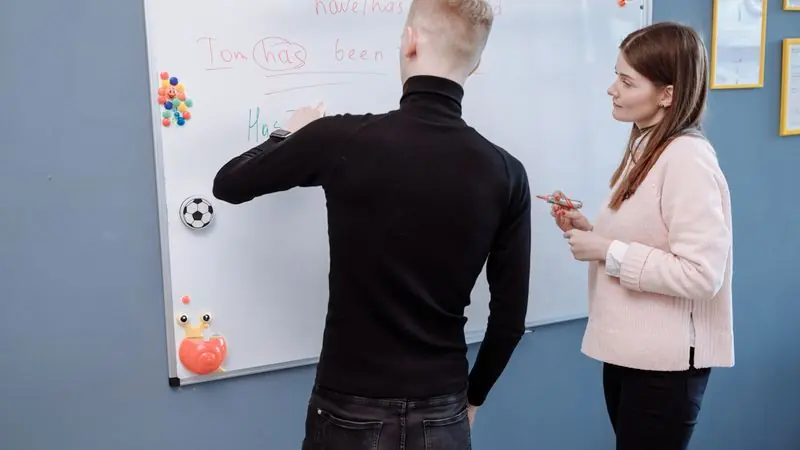
Explaining to a real person works even better, because they ask the questions you'd rather skip. It's one of the best reasons to study with friends now and then.
7. Concrete examples
Abstract ideas are hard to hold on to until you attach them to something specific. The Learning Scientists, a group of cognitive psychologists who turn memory research into practical advice for teachers and students, list concrete examples as one of six core strategies for effective learning. The trick is to use more than one example, so you learn the idea rather than the example.
Try it tonight: for one concept you find slippery, collect two or three examples from different settings. For opportunity cost, that might be a choice in a shop, a choice about your evening, and a government deciding between two projects. Then write one sentence about what they have in common. That sentence is the concept.
8. Dual coding (words plus pictures)
Dual coding means pairing words with visuals: a diagram of the heart next to your notes on blood flow, a timeline for a history topic, a flowchart for a process. You end up with two routes to the same idea. It's another of the Learning Scientists' six strategies.
It isn't about making your notes pretty. A rough sketch you drew from memory is worth more than a colourful poster you copied.
Try it tonight: find one diagram in your textbook, study it for two minutes, then close the book and redraw it with the labels. Compare, fix what's wrong, and try again tomorrow. That's dual coding, active recall and spacing in a single exercise.
9. Planning and reviewing your study
The techniques above are about how you learn. This one is about how you manage your learning: planning what to study, checking whether it's working, and changing course when it isn't. Researchers call it metacognition. The Education Endowment Foundation, which reviews school research in England, rates approaches that teach these skills as high impact for very low cost, worth around seven months of extra progress on average.
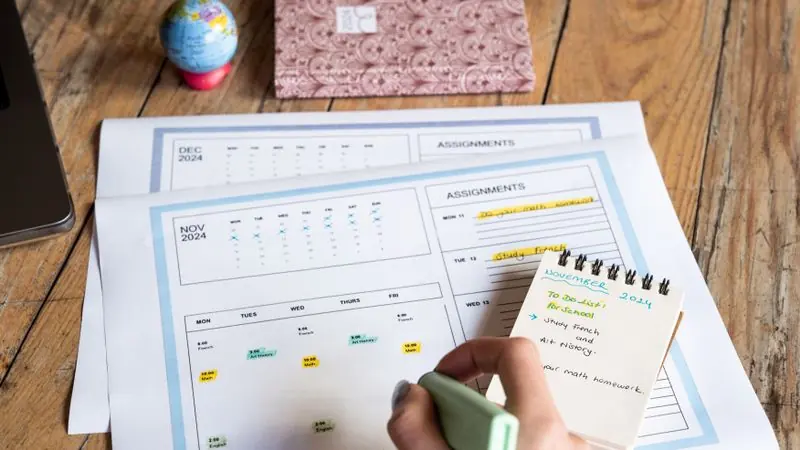
Try it tonight:
- End each session with one question: what can I do now that I couldn't do this morning? If the answer is "not much", change the method, not just the hours.
- Plan the week ahead on Sunday, using specific topics rather than whole subjects.
- Track your real hours by subject. Most students are surprised by which subjects they've been quietly avoiding. A free study timer that logs each session by subject makes this automatic.
10. Timed focus blocks
This one is less about memory and more about getting the work done. Working in fixed blocks, like the Pomodoro Technique's 25 minutes of work and 5 of rest, makes starting easier and stops a session from quietly turning into an afternoon of half-studying.
The research here is honestly mixed. Fixed breaks don't seem to make people learn more than breaks they choose for themselves, but they help students who struggle to start or who push on until they're drained. We go through the studies in our guide to the Pomodoro Technique for studying.
Try it tonight: choose one task, set 25 or 50 minutes, and do only that task until the timer ends. Spend the break away from your phone.
Three habits that feel productive but don't work well
These are the techniques most students lean on, and the ones Dunlosky's review rated low. They aren't useless, but they take a lot of time for what they give back.
- Rereading. The second read feels smooth because the words are familiar, and it's easy to mistake that feeling for knowing them. Read once carefully, then switch to testing yourself.
- Highlighting. Highlighting mostly marks what looks important, not what you've learned. If you like it, highlight on your second pass and turn each highlight into a question.
- Summarising by copying out your notes. Rewriting a chapter in neater handwriting feels like work but asks very little of your memory. A summary written from memory, with the book closed, is a different thing entirely. That's active recall.
Study techniques for competitive exams
For long, crowded syllabuses like JEE, NEET or UPSC, the same techniques apply, but the balance shifts. With hundreds of topics, spaced repetition stops being optional: without planned revision cycles, the early chapters have mostly faded by the time you reach the last ones. Timed mock tests and an error log matter more too, because these exams reward speed and accuracy under pressure as much as knowledge.
A pattern that works for many students is to learn a topic with active recall and worked examples, revise it after a day, a week and a month, and fold it into weekly mixed tests. Keep track of which chapters you've revised in a syllabus tracker so nothing quietly drops out of the cycle.
Putting it together: one 90-minute session
You don't need all ten at once. Here's how several of them fit into a single evening:
| Time | What you do | Technique |
|---|---|---|
| 0–5 min | Blurt everything you remember from your last session on this subject | Active recall, spacing |
| 5–30 min | Learn something new, asking why at each step and sketching one diagram | Elaboration, dual coding |
| 30–35 min | Break, away from your desk | Timed focus blocks |
| 35–65 min | Mixed practice questions, including a few from older topics | Interleaving, active recall |
| 65–70 min | Break | Timed focus blocks |
| 70–90 min | Mark your answers, explain one mistake in your own words, and schedule the next review | Self-explanation, planning |
Try tonight's session with a timer
Set your blocks, tag each one with a subject, and your study hours are logged for you. It's free and runs in your browser.
Start a Free Pomodoro →Frequently asked questions
What is the most effective study technique?
Active recall, also called retrieval practice, has the strongest evidence behind it, along with spaced repetition. Testing yourself on material instead of rereading it makes you far more likely to remember it days and weeks later.
What are the best study techniques for exams?
Active recall, spaced repetition and timed past papers. Together they cover learning the content, keeping it over weeks, and using it under exam conditions. For maths and science, add interleaving, which means mixing different types of problems in one session.
Is rereading notes a good way to study?
Not on its own. Rereading makes material feel familiar, and that feeling is easy to mistake for knowing it. A major 2013 review of study techniques rated rereading as low in usefulness. Reading once carefully and then testing yourself works much better.
What is the Feynman technique?
It's a way to check your understanding by explaining a topic in simple words, as if to someone who has never studied it. Wherever you get stuck or fall back on jargon, you've found a gap. Go back to your notes for that part, then explain it again.
How long should a study session be?
For most students, 25 to 50 minutes of focused work followed by a short break works well, repeated a few times. Several focused blocks spread across the day, with reviews spread across the week, beat one long session the night before.
See which subjects get your hours
A free study timer with subject tracking, streaks and heatmaps, so you can check whether your week matches your plan.
Open the Free Study Timer →Test yourself, space it out, and practise under exam conditions. Those three do most of the work. Add interleaving for problem-solving subjects, explain things in your own words to find the gaps, and keep an honest record of your hours so you know the plan is really happening.
Sources we checked in September 2026: Dunlosky et al., Improving Students' Learning With Effective Learning Techniques (Psychological Science in the Public Interest, 2013); Roediger and Karpicke, Test-Enhanced Learning (Psychological Science, 2006); Rohrer and Taylor, The shuffling of mathematics problems improves learning (Instructional Science, 2007); Rohrer, Dedrick and Stershic, Interleaved Practice Improves Mathematics Learning (Journal of Educational Psychology, 2015); the Education Endowment Foundation's toolkit entry on metacognition and self-regulation; and The Learning Scientists' six strategies for effective learning. The ranking and evidence labels are our own summary, and research findings are paraphrased.