How Many Hours Should You Study for NEET?
NEET rewards what you can remember on exam day, not how long you sat at your desk. Here are realistic hours for each stage, what we know about the 2027 exam, and timetables built around NCERT, revision and mocks.
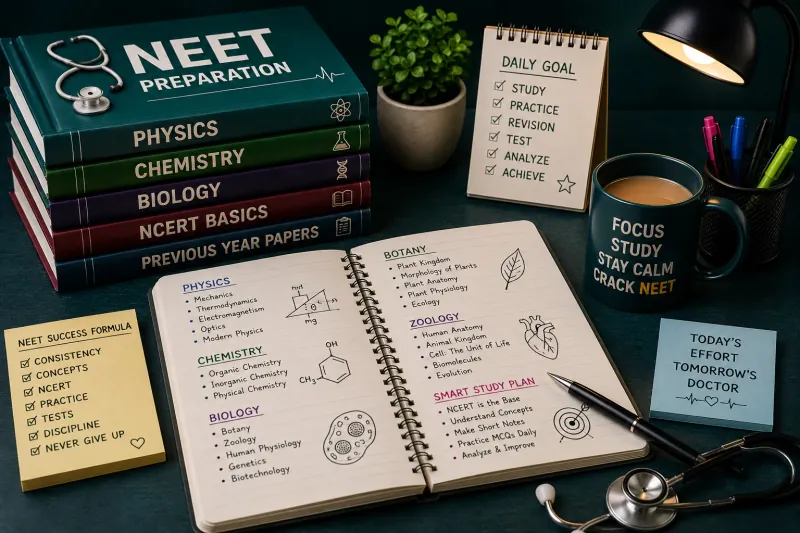
Every NEET aspirant asks this at some point, often after scrolling past someone who says they studied 16 hours a day and scored above 700. The students who actually do well usually describe something quieter: a steady number of focused hours, NCERT read many times over, and revision that never really stops.
This guide starts with a realistic range for your stage. Then it covers what we know about NEET 2027, how to split your time between Biology, Physics and Chemistry, and how to plan the months ahead.
As a rough guide, aim for 3 to 5 focused hours of self-study on a Class 11 school day, 4 to 6 in Class 12, and 7 to 9 as a full-time dropper. Build those hours around NCERT, spaced revision and analysed mocks. In NEET, the third and fourth revision of a chapter is usually worth more than the first read of a new reference book.
What we know about NEET 2027
As of late September 2026, NTA hasn't released the NEET UG 2027 information bulletin, so the details below come from the 2026 exam. Recheck them when the official notice comes out.
| What | Details |
|---|---|
| Format | 180 questions, all compulsory, in 3 hours |
| Questions per subject | 45 Physics, 45 Chemistry and 90 Biology (45 Botany and 45 Zoology) |
| Marking | 720 marks in total: +4 for a correct answer and minus 1 for a wrong one |
| Syllabus | Set by the National Medical Commission. The reduced syllabus introduced for 2024 is still in use, and a 2027 version hadn't been published yet |
| Mode | Pen and paper in 2026. A move to a computer-based test has been discussed but not confirmed |
| Competition | Nearly 20 lakh candidates sat the NEET UG 2026 re-exam, and about 11.21 lakh qualified |
| Seats | About 1.4 lakh MBBS seats in the NMC's 2026-27 seat matrix, not counting institutes such as AIIMS |
2026 was also a reminder that plans need slack. The exam held on 3 May was cancelled after a paper leak, and a re-exam took place on 21 June, so students had to stay exam-ready for seven extra weeks. A plan built on steady weekly hours copes with that far better than one that depends on a final sprint.
How many hours a day, by stage
These are our own planning estimates, based on how serious aspirants and teachers usually structure the day. They're self-study hours, so they don't include school or coaching classes.
| Stage | School or coaching day | Holidays and final months | Rough weekly total |
|---|---|---|---|
| Class 11 (foundation) | 3–5 focused hours | 6–8 hours | 25–35 hours |
| Class 12 | 4–6 focused hours | 7–9 hours | 30–42 hours |
| Dropper (full-time) | 7–9 focused hours | 9–10 hours | 50–60 hours |
Notice the ceiling. Even a full-time dropper tops out at around 10 focused hours a day, and only in the final stretch. A plan that asks for 14 or 15 hours every day for a year usually ends in burnout, not a better score.
Why revision counts more than hours
An hour spent reading a Biology chapter once feels productive. But if you don't come back to it, most of it will be gone by exam day. NEET tests what you can recall and apply months later, so the timing of your revision matters as much as the amount of study.
Memory research backs this up. In a large 2008 study, more than 1,350 people learned a set of facts, reviewed them after gaps of up to three and a half months, and were tested up to a year later. Spacing the review out clearly helped, and the best gap grew with how long they needed to remember the material. For an exam several months away, that means returning to each chapter after a few days, then a few weeks, then a month or two.
A 2013 review of ten common study techniques reached a similar conclusion: practice testing and spaced practice were the most useful, while rereading and highlighting did little. So alongside your hours, keep a second count: how many times you've revised each chapter, and how you did when you tested yourself on it. The NEET syllabus tracker has a revision milestone for every chapter, so you can see which ones are overdue.
How to split your time between the three subjects
- Biology (360 marks): half the paper, so it gets the biggest share of your week, roughly 40 to 45 percent. It's recall-heavy, so it needs frequent short revisions rather than one long read. Read NCERT closely and more than once, including the diagrams, tables and chapter summaries.
- Chemistry (180 marks): about a quarter of your time. Inorganic depends heavily on NCERT and fades without regular revision. Organic needs reaction and mechanism practice, and Physical needs numericals.
- Physics (180 marks): about a quarter of your time, spent mostly on problems. It's the most numerical subject in the paper and the one where many students lose the most marks, so don't let it slide because it feels hard.
Treat these splits as a starting point. Rebalance every week using your latest mock: whichever subject lost you the most marks gets an extra hour or two the following week.
Sample daily timetables
These are examples to adapt, not rules. Every block assumes real breaks.
Class 11, school day (about 4 hours)
- Evening block 1 (90 minutes): the day's Biology chapter from NCERT, then 15 minutes writing down what you remember with the book closed.
- Evening block 2 (90 minutes): Physics or Chemistry problems from the chapter your class is on.
- Night (45 minutes): quick revision of an older Biology chapter and today's mistakes.
Class 12, school day (about 5 to 6 hours)
- Before school (1 hour): Biology revision while your mind is fresh.
- After school (2 to 3 hours): Physics concepts and numericals for your weakest chapter, then Chemistry.
- Evening (2 hours): a new Biology topic, then 20 minutes on today's mistakes and tomorrow's plan.
Dropper, full day (about 8 to 9 hours)
- Morning (3 hours): Biology, a new NCERT topic plus revision of an older one, in two blocks.
- Midday (2 to 3 hours): Physics problems and previous-year questions.
- Evening (2 hours): Chemistry, or a full mock two or three times a week.
- Night (1 hour): mock analysis, a list of weak facts to revise tomorrow, and the next day's plan.
Many students find 25-minute blocks work well for Biology reading and recall, while 45 to 50 minute blocks suit Physics problems. Our guide to the Pomodoro Technique explains how to choose.
Find out how focused your NEET hours really are
Log your study time by subject, keep a daily streak, and see your Biology, Chemistry and Physics balance on a heatmap. It runs in your browser.
Track Your NEET Hours Free →Your plan for the months ahead
NEET UG is usually held in early May. If 2027 follows that pattern, a Class 12 student has about seven months from October. One way to use them:
- October to December: finish the Class 12 syllabus chapter by chapter, with previous-year questions for each one as you go, and revise one Class 11 Biology unit every week.
- January and February: a full revision cycle of Class 11 and a full mock every week, with proper analysis. CBSE board exams usually start in mid-February, so plan lighter NEET days around your papers.
- March and April: two or three full mocks a week under exam timing, NCERT revision for Biology and Inorganic Chemistry, and a short list of facts and formulas you keep getting wrong.
Droppers can follow the same order with more time in each phase. Either way, leave a couple of weeks of slack in case dates move, as they did in 2026.
Sleep is part of the plan
Cutting sleep to fit in more hours is one of the worst trades you can make for an exam that tests memory. In a 2019 study that tracked university chemistry students' sleep with wearable trackers through a semester, those who slept longer, better and on a more regular schedule scored higher on tests, and sleep in the weeks before a test mattered, not just the night before. Six well-rested, focused hours will usually beat nine tired ones.
Mistakes that waste NEET hours
- Swapping NCERT for thick reference books too early. Use reference books for practice questions, but keep NCERT at the centre, especially for Biology and Inorganic Chemistry.
- Reading Biology once and moving on. Without planned revision, it fades within weeks.
- Avoiding Physics because it feels hard. That's often exactly where the rank difference comes from.
- Taking mocks without analysing them. The analysis is where the marks come back, so spend at least as long on it as on the mock itself.
- Copying a topper's 14-hour day. If it costs you sleep, it will cost you recall.
Track your real hours, and your revisions
Most aspirants overestimate their focused time because they count time at the desk. Start a timer when you begin working and stop it when you drift. After a week you'll know whether your nine-hour day is really nine hours, and whether Biology is getting the share it needs.
That's what our free online study timer is for. It logs focused time by subject, keeps a daily streak and shows your week on a heatmap. For a simple method, read how to track your study hours accurately, and if you're weighing medicine against engineering, compare this plan with our JEE study hours guide.
Make this week's NEET hours count
A free study timer with subject tracking, streaks and heatmaps, so you can see where your hours actually go.
Open the Free Study Timer →Frequently asked questions
How many hours should I study for NEET in a day?
As a rough guide, 3 to 5 focused hours on a Class 11 school day, 4 to 6 in Class 12, and 7 to 9 for a full-time dropper, with more on holidays. Count only time spent reading NCERT, revising, solving questions and analysing mocks.
Is 6 hours of study enough for NEET?
For most Class 12 students, yes, if those hours are consistent and built around NCERT, regular revision and mock tests. Six focused hours with frequent revision usually do more than ten hours of reading new material.
How many hours should a NEET dropper study?
Usually 7 to 9 focused hours a day in three or four blocks with real breaks, rising slightly in the final weeks. Give Biology the largest share and protect your sleep, because tiredness hurts recall.
How much time should I give Biology for NEET?
Biology carries 360 of the 720 marks, so give it the largest share of your week, roughly 40 to 45 percent. Because it is recall-heavy, spread that time across frequent short revisions instead of long single reads.
Will NEET 2027 be a computer-based test?
It had not been confirmed as of late September 2026. After the 2026 paper leak, the government said NEET would move to computer-based testing, but in September 2026 it told the Supreme Court the switch was still under active consideration. Wait for the NEET UG 2027 information bulletin.
Pick the range for your stage, then build it around NCERT and spaced revision. Give Biology the biggest share without abandoning Physics, analyse every mock and protect your sleep. Track your real focused hours and your revision count, and leave some slack in the plan in case the dates move.
Sources we checked in September 2026: NTA's NEET UG 2026 syllabus, Indian Express on the NEET UG 2026 notification, The Hindu on the 2024 syllabus reduction, Indian Express on the cancelled May exam and the June re-exam, The Hindu on the NEET UG 2026 results, Times of India on the plan to move NEET online, The Hindu on the computer-based test still being considered, Indian Express on the 2026-27 MBBS seat matrix, Cepeda et al., Spacing effects in learning (Psychological Science, 2008), Dunlosky et al., Improving Students' Learning With Effective Learning Techniques (2013), and Okano et al., Sleep quality, duration, and consistency are associated with better academic performance in college students (2019). Hour ranges are our own planning estimates, and research findings are paraphrased.