The Pomodoro Technique for Studying: How to Use It Well
Twenty-five minutes of work, a five-minute break, repeat. It sounds too simple to need a guide, and for plenty of students it works fine as it is. For others it gets in the way. Here's how the method works, what the research found, and how to set it up for the kind of studying you actually do.

The method comes from Francesco Cirillo, who was an Italian university student in the late 1980s dealing with the usual student problems: distraction, tiredness and putting work off. He started timing short, intense stretches of study with a kitchen timer shaped like a tomato. Pomodoro is Italian for tomato, and the name stuck.
Today there are Pomodoro apps, Pomodoro playlists and hours-long "study with me" livestreams built around it. What gets mentioned less often is that the research on fixed breaks is mixed. They help some students a lot and get in the way for others. This guide covers both sides, so you can choose how to use the method instead of copying the default.
Use the Pomodoro Technique when starting is the hard part: when you're procrastinating, tired, or facing a subject you'd rather avoid. Once you're working well, it's fine to stretch the blocks to 50 minutes or more. The 25 minutes was Cirillo's choice, not a result from research, so treat it as a starting point.
How the Pomodoro Technique works
The basic method has four steps:
- Pick one task. Not "study biology" but "finish the practice questions on photosynthesis". A pomodoro works best when you know what done looks like.
- Set a timer for 25 minutes and work only on that task until it rings. If something else pops into your head, write it on a piece of paper and carry on.
- Take a short break of three to five minutes. Stand up, get some water, look at something that isn't a screen.
- After four pomodoros, take a longer break of 15 to 30 minutes.
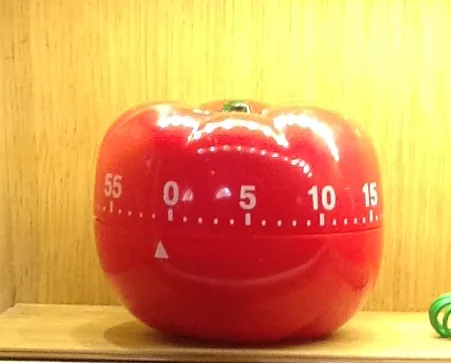
Two parts of Cirillo's full method get skipped a lot. The first is that a pomodoro can't be split. If you stop halfway to reply to a message, that round doesn't count, and you start a fresh 25 minutes. It sounds fussy, but it's the rule that protects your focus. The second is the record. Cirillo has you plan your pomodoros at the start of the day and note how many you actually finished at the end. That's what makes the method useful over weeks instead of hours.
Why it helps so many students
Most of the benefit comes from three things, and none of them has anything to do with the number 25.
- It makes starting easier. "Three hours of chemistry" is hard to begin. "One pomodoro of chemistry" isn't. For a lot of students, the first five minutes are the hardest part of the whole session.
- It takes break decisions off your plate. When the schedule is set in advance, you don't keep asking yourself whether you've earned a rest, and you're less likely to push on until you're exhausted.
- It gives you a unit you can count. "I did eight pomodoros" is a more honest measure than "I studied all afternoon", and it's easy to compare from one week to the next.
What the research actually says
There isn't much research on the Pomodoro Technique itself. Most of the recent studies come from researchers at Maastricht University in the Netherlands, who have compared fixed break schedules with breaks that students choose for themselves. The three most useful ones don't fully agree with each other.
- 2023: fixed breaks felt better. In a study of 87 university students during their normal self-study, some took breaks whenever they wanted and others followed a fixed schedule, either 24 minutes of study and a 6-minute break (close to a classic pomodoro) or 12 minutes and 3. The students who chose their own breaks studied in longer stretches and took longer breaks. They also reported more tiredness and distraction, and less concentration and motivation. Both groups got through a similar amount of work, so the fixed-break students got there in less time.
- 2025: no overall difference. A study of 94 students in a two-hour study session compared classic 25/5 Pomodoro breaks, self-chosen breaks and a method called Flowtime, where you stop when you choose and the break length depends on how long you worked. Tiredness built up faster in the Pomodoro group, and motivation dropped faster with both Pomodoro and Flowtime. By the end, though, the groups didn't differ in tiredness, motivation, productivity, tasks completed or flow.
- 2026: self-chosen breaks felt better. In a study of 176 students reading a text about climate change, the ones who chose their own breaks reported more energy, concentration and motivation, and less distraction, than the ones on a fixed schedule. Scores on the comprehension test that followed were about the same.
Put together, fixed breaks don't seem to make you learn more, at least in short studies like these. What they change is how studying feels, and that depends on the person and the task. If you tend to push on until you're drained, or you struggle to start, a fixed schedule helps. If you're already absorbed in the work, a timer that interrupts you every 25 minutes can make things worse.
One more thing worth knowing: we couldn't find any research showing that 25 minutes is the best length for studying. It's the number Cirillo settled on, and it has lasted because it's short enough to start easily. You're free to change it.
Choosing your Pomodoro interval
Treat the interval as a setting, not a rule. These are the options we see students use most, with what each one is good for.
| Interval | Good for | Watch out for |
|---|---|---|
| 25 / 5 (classic) | Getting started, memorising, problem sets, tired evenings | Cutting off long proofs, essays or coding halfway through |
| 50 / 10 | Most exam study once you've warmed up: past papers, long reading, note-making | The last 15 minutes can drift on a tired day |
| 90 / 20 | Essays, long derivations and projects that need deep focus | Only works when you're rested, and it's hard going on subjects you dislike |
| Exam-length blocks | The final weeks before an exam, to practise sitting a full paper in one go | Tiring, so once or twice a week is plenty |
| Flowtime | Working until your focus fades, then resting 5 minutes after up to 25 minutes of work, 8 after up to 50, and 10 after longer | Easy to overrun without noticing, so log your start and stop times |
If you're not sure, start with 25/5 for a week, then try 50/10 for a week. Keep whichever one gives you more focused minutes in your log, not whichever sounds more serious.
Try a pomodoro right now
Pick one small task and start a 25-minute block. The timer runs in your browser, loops the breaks for you and logs every session, so your pomodoros turn into real study hours.
Start a Free Pomodoro →How to use it for different kinds of study
- Memorising (flashcards, formulas, vocabulary): 25/5 suits this well. Start each new pomodoro by testing yourself on what you covered in the last one before you look at anything new.
- Problem sets and past papers: give each pomodoro a number of questions rather than a topic, like "questions 1 to 6". Check your answers at the start of the next block, not during the break, because marking is work too.
- Reading and note-making: 50/10 usually works better. End each block by writing three or four lines from memory about what you just read. If you can't, the reading didn't go in.
- Essays and long writing: use longer blocks, and try stopping mid-sentence when the timer goes. It sounds odd, but it makes the next block much easier to start.
- Studying with friends: agree on one timer so everyone's breaks line up, and save the chat for the breaks. Working next to people who are also focused makes the quiet stretches easier to stick with, whether you're in the same room or in an online study room.
What to do in a Pomodoro break
The best breaks rest your attention instead of grabbing it. A useful test: if something is designed to keep you watching, it isn't really a break.
- Good short breaks: stand up and stretch, refill your water, walk to another room, look out of a window, or take a minute of slow breathing.
- Good long breaks: eat something, go outside for a walk, talk to someone, or lie down for a few minutes.
- Breaks that tend to backfire: scrolling social media, replying to group chats, starting a video, or checking your marks. Five minutes turns into twenty very easily.
If your phone is the problem, leave it in another room during pomodoros and only pick it up in the long break. It's less painful than it sounds after the first couple of days.
How many pomodoros should you do a day?
It depends on your day, but these are sensible targets to start from. They're our own planning estimates, not numbers from research.
| Your day | Pomodoros (25 min) | Focused study time |
|---|---|---|
| A school or college day | 4–6 | About 1.5 to 2.5 hours |
| A weekend or holiday study day | 8–12 | About 3.5 to 5 hours |
| Exam leave, for a few weeks | 12–14 | About 5 to 6 hours |
With breaks included, eight pomodoros take a little over four hours at your desk, and twelve take about six and a half. If you work in 50-minute blocks, halve the number of blocks. For exam-specific targets, see our guides to JEE study hours and NEET study hours.
Common Pomodoro mistakes
- Treating 25 minutes as sacred. Cirillo's rule is to stop when the timer rings. For studying, a bit of flexibility usually helps more than it hurts: finish the problem you're on, then take your break.
- Using pomodoros on vague tasks. "Revise physics" can fill any amount of time. "Do ten questions on projectile motion" can't.
- Letting breaks stretch. Time the break too. A five-minute break that becomes twenty wipes out most of the next pomodoro.
- Skipping the long break. Four rounds in a row are tiring even when you don't feel it yet. The long break is what lets the next four work.
- Counting pomodoros but not checking the work. Ten pomodoros of rereading notes are worth less than four of practice questions.
- Forcing it when it doesn't fit. If 25-minute blocks keep breaking your concentration on long tasks, switch to longer ones. The goal is focused hours, not loyalty to a method.
Keep a record of your pomodoros
The record is the part of the method most people drop, and it's the part that tells you whether any of this is working. After a week you'll know how many focused blocks you really manage on a school day, which subjects keep getting skipped, and what time of day your pomodoros go best.
You can keep the record on paper, or let a timer keep it for you. Group Study Timer is a free online study timer that logs each session by subject, keeps a daily streak and shows your hours on a heatmap, so the counting takes care of itself. For more on why the count matters, read our guide on how to track your study hours accurately.
Make your next pomodoro count
A free study timer with subject tracking, streaks and heatmaps. It runs in your browser, so there's nothing to install.
Open the Free Study Timer →Frequently asked questions
What is the Pomodoro Technique?
It's a time management method created by Francesco Cirillo in the late 1980s, when he was a university student. You work on one task for 25 minutes, take a short break of three to five minutes, and after four rounds take a longer break of 15 to 30 minutes. Each round is called a pomodoro, the Italian word for tomato, after the tomato-shaped kitchen timer he used.
Is the Pomodoro Technique good for studying?
It helps many students, especially with getting started and with avoiding long sessions that leave them drained. Studies so far show no clear difference in how much students learn compared with taking breaks whenever they like. One 2023 study found fixed breaks left students less tired and more motivated, while a 2026 study found self-chosen breaks felt better, so try it for a week and compare your focused hours.
Why is a pomodoro 25 minutes?
Because that's the length Francesco Cirillo settled on while developing the method. It isn't based on research. Twenty-five minutes is short enough to start easily and long enough to get real work done, but many students do better with blocks of 45 or 50 minutes once they've warmed up.
What should you do during a Pomodoro break?
Something that rests your attention: stand up, stretch, refill your water, walk around or look out of a window. Avoid your phone if you can, because messages and short videos tend to turn a five-minute break into twenty.
Is 50/10 better than 25/5 for studying?
Neither is better for everyone. 25/5 is easier to start and suits memorising, problem sets and tired days. 50/10 suits long reading, essays and past papers, where stopping every 25 minutes breaks your train of thought. Try each for a week and keep the one that gives you more focused hours.
Use pomodoros to get started and to stop yourself studying until you're drained. The research so far suggests fixed breaks change how studying feels more than how much you learn, so pick the interval that keeps you focused longest, whether that's 25 minutes or 50. Then keep a record, because that's how you'll know it's working.
Sources we checked in September 2026: Duke University Academic Resource Center on the Pomodoro Technique; Biwer et al., Understanding effort regulation: Comparing 'Pomodoro' breaks and self-regulated breaks (British Journal of Educational Psychology, 2023); Smits et al., Investigating the Effectiveness of Self-Regulated, Pomodoro, and Flowtime Break-Taking Techniques Among Students (Behavioral Sciences, 2025); and Göksu et al., When to Take a Break: Comparing Effects of Systematic Short (Pomodoro) and Self-Regulated Breaks (Behavioral Sciences, 2026). Pomodoro counts and time estimates are our own, and research findings are paraphrased.