How Many Hours Should You Study for UPSC?
UPSC is a long exam in every sense: a year or more of preparation, three stages, and a syllabus that never quite ends. Here are realistic daily hours for your situation, the CSE 2027 dates, and a plan that treats Prelims and Mains as one preparation.
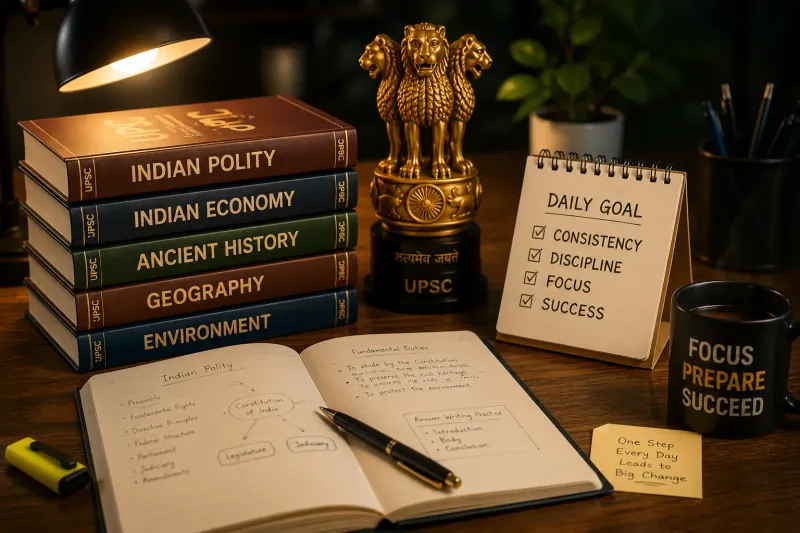
Ask around and you'll hear that UPSC toppers studied 14 or 15 hours a day. Some did, for a few weeks. What most successful candidates describe is less dramatic and much harder to fake: a steady number of focused hours for a year or more, a newspaper every morning, and answer writing long before it felt comfortable.
This guide gives you a realistic range for your situation, then covers the 2027 dates, the exam pattern, and how to turn a huge syllabus into a plan you can actually keep.
As a rough guide, full-time aspirants usually need 6 to 8 focused hours a day, college students 3 to 5, and working professionals 2 to 4 on weekdays with longer weekend sessions. What decides your result is whether you keep that up for 12 to 18 months, revise a small set of sources many times, and practise writing answers.
UPSC CSE 2027: dates and pattern
UPSC has published its calendar for 2027. These are the dates for the Civil Services Examination as of late September 2026.
| Stage | Date or details |
|---|---|
| Notification | 13 January 2027, with applications due by 2 February 2027 |
| Prelims | 23 May 2027. Two objective papers of 200 marks each: General Studies Paper I, and CSAT (Paper II), which only needs 33 percent to qualify |
| Mains | From 20 August 2027, over five days. Nine written papers, including two qualifying language papers. The seven that count are Essay, four General Studies papers and two optional subject papers, for 1,750 marks |
| Interview | The personality test, worth 275 marks, after the Mains results |
| Final merit | Mains plus interview, out of 2,025. Prelims marks only decide who goes through to Mains |
The competition is steep. About 8.2 lakh people applied for CSE 2026, and 13,343 qualified for the Mains, against 1,016 vacancies. That's roughly one vacancy for every 800 applicants. It's also why so many people take more than one attempt, and why a plan that lasts matters more than a heroic month.
How many hours a day, by situation
These are our own planning estimates, based on how serious aspirants and mentors usually structure preparation. They count focused hours only.
| Your situation | Daily focused hours | Rough weekly total | Typical preparation time |
|---|---|---|---|
| Full-time aspirant | 6–8 | 40–50 hours | 12–18 months |
| College student alongside a degree | 3–5 | 20–30 hours | 18–24 months |
| Working professional | 2–4 on weekdays, 6–8 on weekend days | 20–30 hours | 18–24 months |
| Final two or three months before Prelims | Up to 8–10 | 50–60 hours | Short term only |
If you're starting from scratch in October 2026, May 2027 is less than eight months away. That's possible for a full-time aspirant with a strong reading habit, but many people do better treating 2027 as a practice attempt and aiming seriously at 2028. Be honest with yourself about which one you're preparing for.
What matters more than the total
1. Consistency over a year, not intensity for a week
A 12-hour day followed by three days of recovery averages out to less than a steady six. UPSC preparation is long enough that your weekly average matters far more than your best day. Aim for a routine you could repeat on an ordinary Tuesday.
2. Current affairs every day, in a fixed slot
Current affairs feed both Prelims and Mains, and they're impossible to catch up on in the last month. Give them a fixed 45 to 60 minutes a day, ideally in the morning, and make short notes by syllabus topic rather than by date.
3. Answer writing is study, not an extra
Mains is a writing exam: you have to structure a clear answer in a few minutes, again and again, for three hours. Start writing two or three answers a day early in your preparation, even when they're bad. Speed and structure only come from practice.
4. Fewer sources, more revisions
Choose one standard source per subject and revise it several times rather than collecting five books you read once. Research on memory points the same way: a major 2013 review of study techniques rated practice testing and spaced practice as the most useful, and rereading and highlighting as low in usefulness. Test yourself on each topic instead of just reading it again.
5. Prepare Prelims and Mains together
Most General Studies topics appear in both stages. Study each topic for Mains depth, then practise Prelims-style questions on it. Switch to Prelims-only revision and mock tests for the last three or four months before Prelims, then back to answer writing straight after.
6. Choose your optional carefully
The two optional papers carry 500 of the 1,750 Mains marks. Pick a subject you can study for a year without dreading it, with a manageable syllabus and good material, and start it early rather than squeezing it in after Prelims.
Find out how focused your UPSC hours really are
Log your study time by subject, keep a daily streak, and see whether current affairs, GS and your optional are each getting their share.
Track Your UPSC Hours Free →A month-by-month plan for Prelims 2027
This assumes you already have a basic grasp of the syllabus. If you don't, stretch the first phase and look at 2028.
- October to January: General Studies foundations subject by subject, your optional alongside, current affairs daily, and two or three practice answers a day.
- February to April: shift toward Prelims. Revise static subjects in cycles, take a full Prelims test every week and analyse it, and keep CSAT practice going if it isn't comfortably above 33 percent.
- May: revision and mocks only, with normal sleep in the final week.
- After Prelims, until August: intensive answer writing, full-length Mains tests, essay practice and final revision of your optional.
Keep a simple list of GS topics, optional units and current affairs themes, and mark each one as learned, revised once, and revised twice. A custom syllabus tracker works well for this.
Sample daily timetables
Full-time aspirant (about 7 hours)
- Morning (1 hour): the newspaper and current affairs notes.
- Late morning (2.5 hours): one GS subject, in two blocks with a break.
- Afternoon (2 hours): your optional subject.
- Evening (1.5 hours): two or three timed answers, or a Prelims practice set, followed by a quick review.
Working professional (about 3 hours on weekdays)
- Before work (1 hour): newspaper and current affairs notes.
- Evening (2 hours): one GS topic or your optional, ending with one timed answer.
- Weekends (6 to 8 hours a day): the week's revision, a practice test, and longer work on your optional.
Many aspirants use 45 to 50 minute blocks for reading and 7 to 10 minute timed answers for writing practice. Our guide to the Pomodoro Technique explains how to choose a block length that suits you.
Mistakes that waste UPSC hours
- Collecting sources instead of revising them. A fourth book won't help as much as a third revision of the first one.
- Postponing answer writing until after Prelims. By then there's too little time to build speed.
- Letting current affairs pile up. A month of backlog is very hard to clear.
- Taking tests without analysing them. The review shows which subjects and question types cost you marks.
- Burning out in the first three months. A plan you abandon in January is worth less than a modest one you keep until May.
Track your real hours
Over a year, small gaps add up. Start a timer when you begin real work and stop it when you drift, and tag each session by subject. After a month you'll know whether your optional is getting the time it needs, and whether your eight-hour days are really eight hours.
That's what our free online study timer is for. It logs focused time by subject, keeps a daily streak and shows your weeks on a heatmap. For keeping going over a long preparation, read how to stay consistent while studying, and for methods that make each hour count, see our guide to the best study techniques.
Frequently asked questions
How many hours should you study daily for UPSC?
As a rough guide, 6 to 8 focused hours a day for full-time aspirants, 3 to 5 for college students, and 2 to 4 on weekdays for working professionals, with longer weekend sessions. Keeping it up for 12 to 18 months matters more than any single long day.
Is 6 hours of study enough for UPSC?
For many full-time aspirants, yes, if those six hours are focused and include daily current affairs, regular answer writing and repeated revision. Six consistent hours over a year usually beat longer days that can't be sustained.
Can I clear UPSC in one year?
Some candidates do, usually full-time aspirants with a strong reading habit who start early and stay consistent. Many others take two or more attempts. If you are starting from scratch, plan for 12 to 18 months of steady preparation.
How many hours should a working professional study for UPSC?
Usually 2 to 4 focused hours on weekdays and 6 to 8 hours on weekend days, which adds up to about 20 to 30 hours a week. Most working aspirants plan for 18 to 24 months of preparation.
When is UPSC Prelims 2027?
UPSC's calendar puts the Civil Services Prelims on 23 May 2027. The notification is due on 13 January 2027, applications close on 2 February 2027, and the Mains is scheduled to start on 20 August 2027.
Pick a daily range you can keep for a year, not a week. Read the newspaper every day, write answers early, revise a small set of sources many times, and prepare Prelims and Mains together. Track your real hours by subject so your optional and current affairs don't quietly fall behind.
Sources we checked in September 2026: Indian Express on the UPSC calendar for 2027, Economic Times on the 2027 Prelims and Mains dates, Indian Express on the CSE 2026 Prelims result, PW on CSE 2026 applicants and vacancies, Vajiram and Ravi on the CSE exam pattern, the UPSC website, and Dunlosky et al., Improving Students' Learning With Effective Learning Techniques (2013). Hour ranges are our own planning estimates, and research findings are paraphrased.