How Many Hours Should You Study for CLAT?
CLAT is a two-hour paper built on passages, so reading speed and careful reasoning count for more than facts you've memorised. Here are realistic hours for your stage, what CLAT 2027 looks like, and plans for the weeks left and for CLAT 2028.
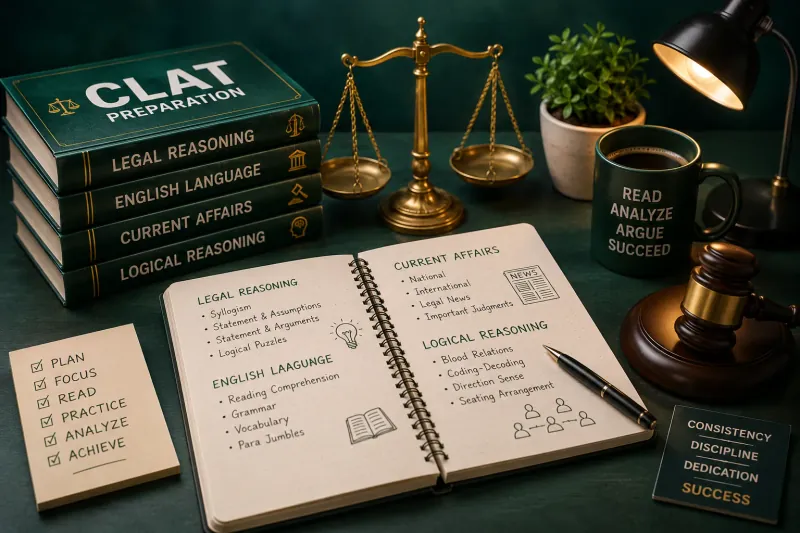
CLAT looks like a law exam, but on the day it behaves like a reading test. Every section is built on passages or short sets of information, and you get two hours for 120 questions. Memorising more rarely moves your score much. Reading quickly and accurately, applying the rule in front of you, and having sat enough full papers to pace yourself do.
Below are realistic daily hours for your stage, what CLAT 2027 looks like, and plans for the ten weeks left and for CLAT 2028.
As a rough guide, aim for 1 to 1.5 focused hours of CLAT work a day in Class 11, 2 to 3 in Class 12 alongside school, and 5 to 6 as a full-time dropper, plus 30 to 45 minutes of serious reading every day at every stage. In the last ten weeks, full mocks and their analysis should take up most of your CLAT time.
CLAT 2027 at a glance
The Consortium of National Law Universities runs CLAT. These details are from its official CLAT 2027 pages, as of late September 2026.
| What | Details |
|---|---|
| Exam date | Sunday 6 December 2026, 2 pm to 4 pm (to 4.40 pm for eligible PwD candidates) |
| Mode | Offline, pen and paper, at test centres |
| Applications | Online from 3 August to 31 October 2026, 11.59 pm |
| Application fee | Rs 4,000, or Rs 3,500 for SC, ST, BPL and PwD candidates |
| Paper | 120 multiple-choice questions in 2 hours, one mark each, minus 0.25 for every wrong answer |
| Sections | English Language, Current Affairs including General Knowledge, Legal Reasoning, Logical Reasoning and Quantitative Techniques |
| Universities | 26 National Law Universities |
| Class 12 students | You can apply if you sit your Class 12 exams between March and May 2027, but you must show you've passed at admission |
| Admit card | Date to be announced on the CLAT website |
| Counselling | December 2026 or January 2027 |
CLAT keeps getting busier. For CLAT 2026, held on 7 December 2025, 92,344 candidates applied, 17 per cent more than the year before, and 75,009 of them registered for the undergraduate paper. Almost 97 per cent of UG applicants turned up on the day. If two candidates finish on the same score, the Consortium breaks the tie on marks in the legal section first, then in favour of the older candidate, then by a computerised draw.
What each section asks of you
The official syllabus describes CLAT as a test of comprehension and reasoning rather than prior knowledge. Most passages are around 450 words, and the Consortium says its English passages are pitched so a Class 12 student could read one in about 5 to 7 minutes.
| Section | What it tests | Rough share |
|---|---|---|
| English Language | The main point, inferences, arguments and word meaning in fiction and non-fiction passages | About a fifth |
| Current Affairs including GK | News-based passages on India and the world, arts and culture, international affairs and history | About a quarter |
| Legal Reasoning | Applying principles in a passage to new facts, with no prior knowledge of law needed | About a quarter |
| Logical Reasoning | Arguments, premises, conclusions, what strengthens or weakens them, and inferences | About a fifth |
| Quantitative Techniques | Class 10 maths on numerical information: ratios, basic algebra, mensuration and statistics | About a tenth |
The exact split moves by a few questions each year. The December 2024 paper had 24 English, 28 Current Affairs, 32 Legal Reasoning, 24 Logical Reasoning and 12 Quant questions. Last December, according to IMS's paper analysis, Logical Reasoning was made up entirely of analytical puzzles rather than argument passages, which surprised many candidates. Practise both kinds.
The same analysis counted about 20 passages and sets in the December 2025 paper. At 5 to 7 minutes each, reading alone would take most or all of your two hours. So the skill you're really training is reading fast with full understanding, then finding what each question needs without rereading the whole passage.
Marking matters too. A wrong answer costs a quarter of a mark, so four wrong answers wipe out one right one. A blind guess gains you almost nothing on average, but once you've ruled out two options, a guess is usually worth taking.
What changed for 2027, and what might change for 2028
You may have read that the CLAT pattern changed for 2027 after an expert committee chaired by Justice Indu Malhotra. That isn't quite right. Here is what the official documents say.
In September 2025, the Consortium's Advisory Board, chaired by former Supreme Court judge Justice Indu Malhotra, set up a five-member committee of legal academics, co-convened by Professor Dev Gangjee of Oxford and Professor Tarunabh Khaitan of the LSE. Its final report, submitted in February 2026, recommended for the UG paper:
- three sections instead of five: Logical Reasoning and Legal Aptitude, Language and Comprehension, and Quantitative Techniques
- removing the General Knowledge and Current Affairs section completely, and merging Legal and Logical Reasoning into one section
- no more than 10 to 15 questions per section, still in two hours, to reward careful thinking over speed
- no essay for now, though it set out a route to adding one later
On 18 July 2026, the Consortium's Governing Body decided there would be no change to the syllabus, pattern or sections of CLAT 2027. Paper setters will adopt the committee's suggestions on question format and quality where they can. The report was open for public feedback until 31 August 2026, and its proposals will be considered for CLAT 2028, working with a committee that the Office of the Chief Justice of India is to set up. As of late September 2026, no decision on the 2028 format had been announced.
So if you're sitting CLAT 2027, prepare for the familiar five-section paper, Current Affairs included. And since the committee criticised questions whose answers can be lifted word for word from the passage, practise questions that make you infer, not just locate.
How many hours a day, by stage
These are our own planning estimates, based on how serious aspirants and teachers usually plan. They count focused CLAT hours only, not school, coaching or board study, and the daily reading sits on top.
| Your stage | Focused CLAT hours a day | Daily reading | Where the time goes |
|---|---|---|---|
| Class 11 | 1–1.5 | 30 minutes | Reading habit, how legal and logical passages work, Class 10 maths |
| Class 12, alongside school and boards | 2–3 | 30–45 minutes | Timed sectional practice, current affairs notes, a full mock every week or two from the summer |
| After Class 12, as a dropper | 5–6 | 45–60 minutes | Sectional work, then two full mocks a week in the last three months |
| Final ten weeks, Class 12 | 3–4 on school days, 6–7 on weekends and holidays | 30 minutes | Full mocks, analysis, your error log and current affairs revision |
| Final ten weeks, dropper | 6–7 | 30–45 minutes | Two or three full mocks a week, each analysed within a day |
CLAT falls in December, a couple of months before most Class 12 board exams, so for many students the final stretch overlaps with school tests and pre-boards. That's why the Class 12 numbers are modest. Two or three sharp hours a day from April to November add up to far more than a few ten-hour Sundays. Your boards still matter, because you need to pass Class 12 to take up an NLU seat.
What matters more than the total
1. Read every day, and time it
Every section depends on reading, and reading speed builds slowly. Read 30 to 45 minutes a day of editorials and long-form non-fiction, including topics you'd normally skip. Time yourself on a 450-word piece, then write the author's main point in one sentence without looking back.
2. Apply the rule you're given
Legal Reasoning passages hand you a principle and a set of facts, and the official syllabus says you need no prior knowledge of law. The common mistake is answering from your sense of fairness, or from half-remembered real law, instead of the principle on the page. When you check a set, find the exact words in the principle that decide each answer.
3. Keep current affairs running all year
For CLAT 2027, Current Affairs is still about a quarter of the paper. The Consortium's FAQs say there is no fixed time frame for the section. A practical approach is to follow the past year of news closely, keep short weekly notes from your newspaper and revise them every month. A year of news doesn't fit into October.
4. Mocks, then analysis
A full CLAT mock takes two hours. Give the analysis at least as long. For each wrong or skipped question, note whether you misread the passage, misapplied the principle, ran short of time or simply didn't know. After five or six mocks, the pattern tells you what to fix first.
5. Don't skip Quant because it's small
Quantitative Techniques is only about a tenth of the paper, but the maths is Class 10 level. Half an hour a few times a week on ratios, percentages, averages and data sets keeps those marks within reach.
6. Revise your mistakes, not your notes
Keep an error log of questions you got wrong and redo them a week or two later. A major 2013 review of study techniques rated practice testing and spaced practice as the most useful ways to learn, and rereading as one of the least. Your error log is a practice test built from your own weak spots.
Find out how focused your CLAT hours really are
Log reading and each section as separate subjects, keep a daily streak, and see on a heatmap whether your reading habit is holding. It runs in your browser.
Track Your CLAT Hours Free →If CLAT 2027 is about ten weeks away
You won't transform your reading speed in ten weeks, but you can get much better at taking this particular paper. If you haven't applied yet, do that first, before 31 October. Then one way to use the time:
- Weeks 1 and 2: one full mock a week with a thorough analysis, plus timed sectional practice on your two weakest sections.
- Weeks 3 to 7: two full mocks a week. Between them, redo your error log, keep reading daily and revise a month of current affairs each week.
- Weeks 8 and 9: two or three mocks a week, on paper, starting at 2 pm and timed with a watch rather than your phone. Revise the past year of current affairs once more.
- Final week: one or two last mocks early in the week, then light revision of your errors and notes. Keep your sleep normal and check your admit card and centre well before Sunday.
Because CLAT is offline, practise on printed papers and mark answers on a separate OMR-style sheet, so the answer sheet feels routine by December. In Class 12, keep weekday work to 3 or 4 hours and put full mocks on weekends and holidays.
If you're starting now for CLAT 2028
Recent CLATs have been held in the first week of December, but the date for CLAT 2028 hasn't been announced, and its format may change if the Consortium adopts the committee's proposals. So build the skills that count in either version: reading, analysing arguments, applying rules to facts and working with numbers.
- Now to March 2027: 30 minutes of reading a day and a few untimed Legal and Logical Reasoning sets a week. Refresh Class 10 maths once a week.
- April to August 2027: two to three hours a day, with timed sectional practice in every section and a full mock every two weeks.
- September to December 2027: a full mock every week, rising to two or three a week, with an analysis after each one.
Keep reading the news either way. It builds reading speed, and today's Legal Reasoning section already rewards awareness of contemporary legal and moral issues. Just don't spend months memorising static GK before the 2028 format is confirmed.
Track your real hours
CLAT preparation is mostly reading, and reading is easy to overcount. Twenty minutes with the newspaper and your phone nearby can feel like an hour. Start a timer when you begin a focused block, stop it when you drift, and log reading, each section and mocks as separate subjects.
That's what our free online study timer is for. It logs focused time by subject, keeps a daily streak and shows your weeks on a heatmap, and you can set up a custom syllabus tracker for CLAT topics and months of current affairs. If you're balancing CLAT with boards, see our guide to Class 12 CBSE study hours, and if you're also considering an IIM's five-year programme, read about IPMAT study hours.
Frequently asked questions
How many hours a day should I study for CLAT?
As a rough guide, 1 to 1.5 focused hours a day in Class 11, 2 to 3 in Class 12 alongside school, and 5 to 6 as a full-time dropper, plus 30 to 45 minutes of reading every day. In the final ten weeks, full mocks and their analysis should take up most of that time.
Is 2 months enough for CLAT?
Two months is enough to improve how you take the paper: pacing, question choice, current affairs revision and fixing repeated mistakes. It is rarely enough to build reading speed from scratch, so put most of your time into mocks, analysis and your weakest sections.
How do I prepare for CLAT with Class 12?
Keep a daily reading habit through the year, add 2 to 3 focused hours of CLAT practice on school days, and take a full mock every week or two from the summer. CLAT is in December, before most board exams, so plan pre-board revision around your mock weekends.
When is CLAT 2027 and when does registration close?
CLAT 2027 is on Sunday 6 December 2026, from 2 pm to 4 pm, as an offline pen-and-paper test. Online applications opened on 3 August 2026 and close at 11.59 pm on 31 October 2026.
Has the CLAT pattern changed for 2027?
No. The Consortium has said there will be no change to the syllabus, pattern or sections for CLAT 2027, so the UG paper still has 120 questions across five sections in two hours. An expert committee has proposed a three-section paper without General Knowledge, but that is being considered for CLAT 2028, not 2027.
How many mocks are enough for CLAT?
There is no official number. As our own rough guide, 15 to 25 full mocks in the final three months is plenty if you analyse each one properly, since the analysis is where most of the improvement comes from.
Build a timed reading habit early, apply the rule on the page in Legal Reasoning, keep current affairs notes running, and let full mocks and their analysis fill the final ten weeks. Prepare for the five-section paper in 2027, watch for the Consortium's decision on 2028, and track your real hours so your reading time is counted honestly.
Sources we checked in September 2026: the Consortium's CLAT 2027 UG instructions, UG syllabus and FAQs, its July 2026 press release and the CLAT Expert Committee Report 2026, Indian Express on the expert panel's proposals, on CLAT 2026 applications and turnout and on the section split in the December 2024 paper, IMS's analysis of the December 2025 paper, and Dunlosky et al., Improving Students' Learning With Effective Learning Techniques (2013). Hour ranges, mock counts and plans are our own planning estimates, and research findings are paraphrased.