How Many Hours Should You Study for IPMAT?
IPMAT tests school maths and English under tight time limits, so it rewards steady practice more than long hours. Here are realistic numbers for each stage, how the three IPM entrance tests differ, and a simple plan for 2027.
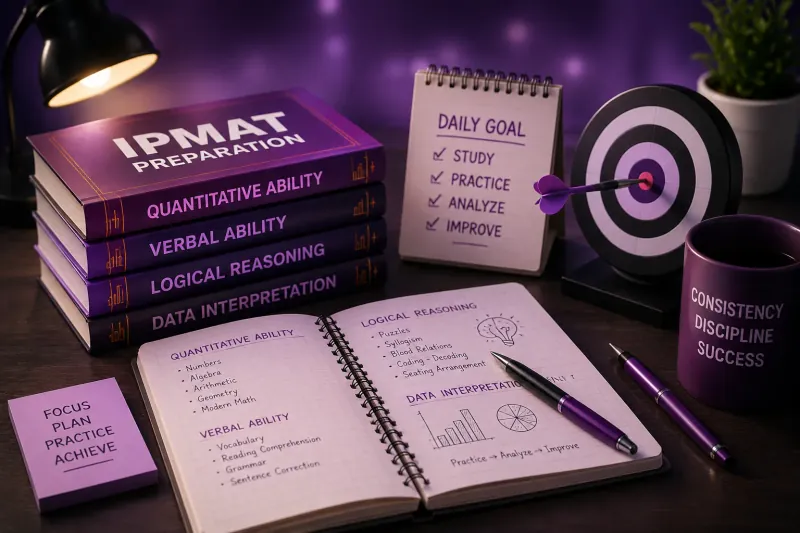
IPMAT is the entrance test for the five-year Integrated Programme in Management at IIM Indore, and a similar test is run by IIM Rohtak. The maths is school level and the English is reading and grammar you already know. What makes it hard is doing it quickly and accurately, a few weeks after your board exams.
So the useful question isn't how many hours in total. It's how much regular, timed practice you can fit around Class 12, and how well you use the weeks after boards.
As a rough guide, 30 to 60 minutes a day in Class 11 if you start early, 1 to 2 hours a day alongside Class 12, and 5 to 6 focused hours a day in the weeks after your last board exam. Put most of that time into timed maths practice and daily reading.
The three IPM entrance tests
Most students sit more than one. These are the patterns from the 2026 cycle. The 2027 notifications hadn't come out when we checked in late September 2026, so confirm the details when they do.
| Test | Who runs it | Format in 2026 |
|---|---|---|
| IPMAT Indore | IIM Indore | 90 questions in 120 minutes, in three separately timed sections: Quantitative Ability short answer, Quantitative Ability multiple choice, and Verbal Ability. Multiple-choice questions score +4 and minus 1, and short-answer questions have no negative marking. Held on 4 May 2026 |
| IPMAT Rohtak | IIM Rohtak | 120 questions in 120 minutes, 40 each in Quantitative Ability, Logical Reasoning and Verbal Ability, with +4 and minus 1 and no fixed time per section |
| JIPMAT | NTA, for IIM Bodh Gaya and IIM Jammu | 100 questions for 400 marks in 150 minutes, covering quantitative aptitude, reasoning and verbal ability |
The overlap is large, so one preparation covers all three. The differences are in timing and in logical reasoning, which Rohtak and JIPMAT test as its own section. Indore's short-answer questions, where you type a number instead of choosing an option, need exact working, so practise them separately.
How many hours a day, by stage
These are our own planning estimates, on top of normal school study.
| Your stage | IPMAT practice a day | What the time is for |
|---|---|---|
| Class 11, starting early | 30–60 minutes | Maths basics you may have skipped, and a daily reading habit |
| Class 12, alongside boards | 1–2 hours | Timed maths sets, reading comprehension and a weekly mock |
| After boards, before IPMAT | 5–6 hours | Full mocks, their review and your weakest topics |
| A gap year | 4–6 hours | A steady routine with a mock every week, rising to two or three |
The weeks between boards and IPMAT are usually short. Plan them before your boards begin, so rest days don't quietly turn into rest weeks.
Where your hours should go
Quantitative ability
This is where most scores are won or lost. The questions draw on school maths such as algebra, arithmetic, number systems and geometry, but they're set to be solved quickly. Learn each topic once, then practise it in timed sets. Keep a list of the question types you get wrong and redo them a week later.
Verbal ability
Reading speed and vocabulary build slowly, so start early. Read 20 to 30 minutes a day, such as a newspaper editorial or a long article, and answer a few questions on it. Add grammar and vocabulary practice two or three times a week.
Logical reasoning
If you're sitting IPMAT Rohtak or JIPMAT, give reasoning its own practice: puzzles, arrangements, series and simple data interpretation. A few timed sets a week is enough for most students.
Mocks and review
From a couple of months before the test, take a full mock every week, then two or three a week after boards. Spend as long reviewing a mock as taking it. The review shows which questions to skip, which is half the skill in a test with negative marking. Research on learning backs this: a major 2013 review rated practice testing as one of the two most effective study techniques.
See where your IPMAT hours really go
Log your practice by section, keep a daily streak, and check that verbal and reasoning get their share. It runs in your browser.
Track Your IPMAT Hours Free →IPMAT, boards and CUET together
Your board maths is the base for quantitative ability, so good board preparation is also IPMAT preparation. Many students also sit CUET, where the General Test and English paper overlap with IPMAT reasoning and verbal ability. A sensible order is:
- October to January: board study, plus 1 to 2 hours a day of timed IPMAT practice and daily reading.
- February and March: board exams first. Keep IPMAT to short practice on days between papers.
- After your last board exam: full IPMAT days, with mocks every few days, then CUET practice as its date gets closer.
For board and CUET hours, see our guides to Class 12 study hours and CUET study hours.
Mistakes that waste IPMAT hours
- Learning maths without timing it. Knowing a method isn't enough if it takes three minutes.
- Leaving reading until the last month. Verbal ability improves slowly.
- Guessing wildly. With minus 1 for a wrong answer, careless guesses cost marks.
- Taking mocks without reviewing them. The review is where the improvement happens.
- Ignoring the short-answer section. It has no negative marking, so accurate working there is valuable.
Track your real hours
Start a timer when you begin a timed set or a mock, and stop it when you drift. After a week you'll see whether your weakest section is getting enough time. That's what our free online study timer is for: it logs focused time by subject and keeps a daily streak. You can also list IPMAT topics in a custom syllabus tracker and tick them off as you go.
Frequently asked questions
How many hours should I study daily for IPMAT?
As a rough guide, 1 to 2 hours a day of IPMAT practice alongside Class 12, and 5 to 6 focused hours a day in the weeks after your last board exam. Starting in Class 11 with 30 to 60 minutes a day makes the final weeks much easier.
Is 3 months enough to prepare for IPMAT?
It can be, if your school maths is solid and you practise every day. Use the time for timed maths sets, daily reading, a mock every week and a careful review of each mock.
What is the difference between IPMAT Indore and IPMAT Rohtak?
In 2026, IPMAT Indore had 90 questions in three timed sections covering quantitative and verbal ability, including short-answer maths questions. IPMAT Rohtak had 120 questions across quantitative ability, logical reasoning and verbal ability, with no fixed time per section.
Can I prepare for IPMAT along with Class 12 boards?
Yes. Board maths is the base for the quantitative section, so study it properly and add 1 to 2 hours a day of timed IPMAT practice and reading. Keep IPMAT light during board exams, then switch to full days once your last paper is over.
Practise school maths under time, read every day for verbal ability, and add reasoning if you're sitting Rohtak or JIPMAT. Take weekly mocks and review them properly, plan the weeks after boards in advance, and track your real practice hours by section.
Sources we checked in September 2026: Indian Express on IPMAT 2026, PW on the IPMAT exam pattern, PW on the IPMAT Rohtak pattern, iQuanta on IPMAT and JIPMAT marking, the IIM Indore website, and Dunlosky et al., Improving Students' Learning With Effective Learning Techniques (2013). Hour ranges are our own planning estimates.