How Many Hours Should You Study for Class 12 Boards?
Class 12 is two exams at once for most students: the board and an entrance test. The trick isn't finding more hours. It's making each hour count for both. Here are realistic numbers by stream, how the marks work, and a plan from now to February.
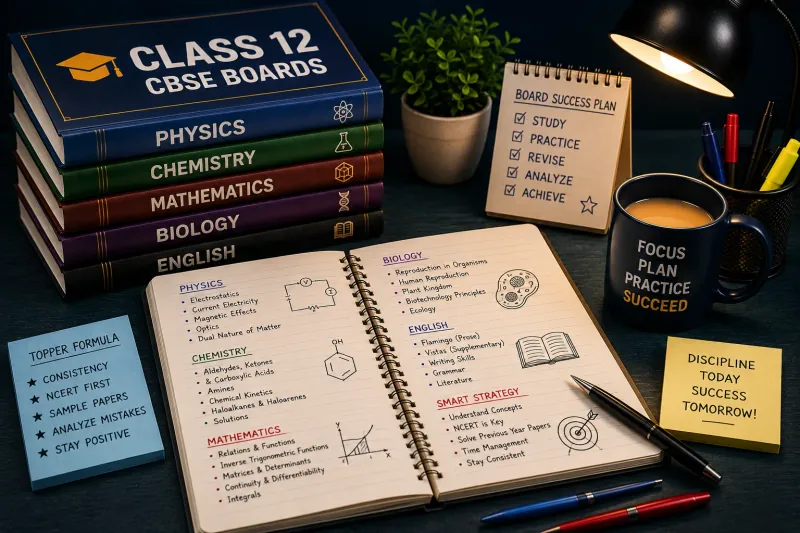
Class 12 is the year when everyone seems to have an opinion about how many hours you should be studying. Relatives say eight, coaching centres say ten, and someone online says fourteen. Most students who do well describe something more ordinary: a steady few hours on school days, longer days at weekends, and a lot of practice with the kind of questions the board actually asks.
This guide gives you realistic ranges for your situation, explains how the marks are split, and lays out a plan from October to the board exams.
As a rough guide, 3 to 4 focused hours of self-study on school days is enough for boards alone, and 5 to 6 if you're also preparing for JEE, NEET or CUET, with longer days at weekends and in the final weeks. What matters most is covering every chapter from NCERT, then practising sample papers under time and learning how the board wants answers written.
How Class 12 boards are marked
Knowing where the marks come from helps you plan your hours. The CBSE curriculum for 2026-27 sets out the details for each subject, but the broad pattern looks like this.
| What | Details |
|---|---|
| Marks per subject | 100, split between the written board paper and practical or internal assessment |
| Science subjects | Physics, Chemistry and Biology are usually 70 marks of theory and 30 of practical work |
| Maths and languages | Usually 80 marks of theory and 20 of internal assessment |
| Passing | At least 33 percent in each subject, and in the theory and practical parts separately |
| Exam timing | The 2026 exams began on 17 February 2026. The 2027 date sheet hadn't been released when we checked |
| Number of exams | One main board exam for Class 12. The two-exam system that started in 2026 applies to Class 10 |
Two points follow from this. The practical and internal marks are a real share of your result, so don't leave lab files, projects and viva preparation to the last week. And because the theory paper is the larger part, practising how to write answers under time matters as much as knowing the content.
How many hours a day, by situation
These are our own planning estimates. They're self-study hours, so they don't include school or coaching classes.
| Your situation | School days | Weekends and holidays | Final six to eight weeks |
|---|---|---|---|
| Boards only (any stream) | 3–4 focused hours | 5–6 hours | 6–8 hours |
| Boards plus JEE or NEET | 5–6 hours, combined | 7–9 hours | 8–9 hours, board-focused near the exams |
| Boards plus CUET, CLAT or IPMAT | 4–5 hours | 6–7 hours | 7–8 hours |
If you already spend long days in school and coaching, six more hours of self-study can be too much. Check how you feel after three weeks, not three days. A routine you can keep until February is worth more than a heroic week in October.
Do board marks matter if you're preparing for an entrance?
Yes, more than many students think. To get a seat at an IIT, NIT, IIIT or other government-funded technical institute through JoSAA, candidates in the General, EWS and OBC-NCL categories need at least 75 percent in Class 12, or a place in the top 20 percentile of their board. The threshold is 65 percent for SC and ST candidates. A great JEE rank doesn't help if your board marks fall short.
For CUET, the link is even closer: the domain subject papers are largely based on the Class 12 syllabus. So good board preparation is also good entrance preparation, as long as you add practice in the entrance format.
How to prepare for boards and an entrance together
1. Learn each concept once, then practise it in both formats
Don't split your day into "board time" and "entrance time" for the same chapter. Learn a topic properly from NCERT, then do two kinds of practice on it that week: board-style written answers and entrance-style objective questions. One set of hours serves both exams.
2. Know the difference between the two formats
Boards reward complete, well-structured answers with steps, diagrams and correct terms. Entrance tests reward speed and accuracy on objective questions. Students who only practise one style tend to lose marks in the other, so do some of each every week.
3. NCERT is the common ground
NCERT textbooks are the base for board papers, and they matter a lot for NEET and for CUET's domain subjects too. Read them closely, including examples, diagrams and in-text questions, before you move on to reference books.
4. Practise with official papers
CBSE publishes sample question papers and marking schemes on its academic website. Use them from December onward to learn how marks are awarded, and time yourself on full papers in January. The marking schemes show exactly what an answer needs to earn full marks.
5. Switch to board mode at the right time
If you're preparing for JEE, Session 1 falls in late January, a few weeks before boards. Many students keep a combined routine until then, and move to mostly board preparation for the three or four weeks before their first paper. NEET, CUET and JEE Session 2 come after boards, so there's time to switch back.
See where your hours really go: boards or entrance
Log your study time by subject, keep a daily streak, and check that no subject is quietly falling behind. It runs in your browser.
Track Your Class 12 Hours Free →Stream by stream
- Science (PCM or PCB): the 30 practical marks per science subject are worth securing early, so keep your lab file up to date and prepare for the viva in December. For theory, practise numericals and derivations in board style, with every step written out.
- Commerce: Accountancy rewards daily practice of full questions, not just reading. Business Studies has case-based questions, so practise applying concepts to short scenarios. In Economics, practise diagrams and labelled graphs.
- Humanities: long answers carry many marks, so practise writing to time and to structure. Keep map work for History and Geography going every week, and practise source-based questions.
A month-by-month plan to the 2027 boards
- October and November: finish the syllabus in every subject, revise each chapter a week after you finish it, and do a few sample-paper questions on it.
- December: practical files, projects and viva preparation, plus a first full revision. Many schools hold pre-boards around December or January, so treat them as a rehearsal.
- January: timed full sample papers, one or two a week per subject, checked against the marking scheme. If you're writing JEE Session 1, keep a lighter board routine until it's over.
- February and March: the exams. Between papers, revise the next subject from your notes and the questions you got wrong, and keep your normal sleep.
The CBSE boards syllabus tracker lets you tick off each chapter as you learn it, revise it and practise it, so you can see which ones still need work.
Sample daily timetables
Boards only (about 3 to 4 hours on a school day)
- After school (90 minutes): the chapter you're currently learning in your hardest subject.
- Evening (90 minutes): a second subject, ending with a few written answers or numericals.
- Night (30 minutes): quick revision of an older chapter and tomorrow's plan.
Boards plus JEE or NEET (about 5 to 6 hours on a school day)
- Before school (1 hour): Maths or Biology practice while you're fresh.
- After school (2 to 3 hours): one subject in depth, with entrance-style questions after the concept work.
- Evening (2 hours): a second subject, with board-style written answers on this week's chapters, then 15 minutes on today's mistakes.
Block length is up to you. Many students like 45 to 50 minute blocks for problem-solving and shorter ones for revision. Our guide to the Pomodoro Technique explains how to choose.
Mistakes that waste Class 12 hours
- Ignoring board-style answer writing because you're busy with entrance questions.
- Leaving practicals and projects to the last week, when they're 20 or 30 marks per subject.
- Collecting reference books before finishing NCERT.
- Skipping the marking schemes. They show exactly what earns marks.
- Cutting sleep in the exam months. It makes revision slower and exam-day mistakes more likely.
Track your real hours
With two sets of exams, it's easy for one subject or one exam to quietly get less time than you think. Start a timer when you begin real work, stop it when you drift, and tag each session by subject.
That's what our free online study timer is for. It logs focused time by subject, keeps a daily streak and shows your week on a heatmap. If you're also preparing for an entrance, see our guides to JEE study hours, NEET study hours and CUET study hours, and for methods that make revision stick, read about the best study techniques.
Frequently asked questions
How many hours should I study daily for Class 12 boards?
As a rough guide, 3 to 4 focused hours on school days for boards alone, and 5 to 6 if you are also preparing for JEE, NEET or CUET, with longer days at weekends and in the final weeks. Consistency from October to February matters more than any single long day.
How do I study for boards and JEE or NEET at the same time?
Learn each concept once from NCERT, then practise it in both formats in the same week: written board-style answers and objective entrance-style questions. Keep a combined routine until a few weeks before boards, then focus on board papers until the exams are over.
How many marks do I need to pass Class 12 CBSE?
At least 33 percent in each subject. In subjects with practicals or internal assessment, you need 33 percent in the theory paper and in the practical or internal part separately.
Do Class 12 board marks matter for JEE?
Yes. For a seat at an IIT, NIT, IIIT or other government-funded technical institute through JoSAA, General, EWS and OBC-NCL candidates need at least 75 percent in Class 12 or a place in the top 20 percentile of their board. The threshold is 65 percent for SC and ST candidates.
When will the CBSE 2027 date sheet come out?
It had not been released as of 28 September 2026. For reference, the 2026 main exams began on 17 February 2026, so plan your revision on the assumption of a similar start and check cbse.gov.in for the official date sheet.
Cover every chapter from NCERT, then practise it in the format each exam wants. Secure your practical marks early, use CBSE's sample papers and marking schemes from December, and switch to board mode a few weeks before your first paper. Track your real hours by subject so nothing falls behind.
Sources we checked in September 2026: the CBSE curriculum for 2026-27, Indian Express on Class 12 passing marks and the theory and practical split, Times of India on the 2026 board exam dates and rules, Indian Express on the 75 percent rule for JoSAA admissions, and the CBSE website. Hour ranges are our own planning estimates.