How Many Hours Should You Study for CUET?
Most of CUET's domain subjects come straight from your Class 12 syllabus, so the real question isn't how many hours in total. It's how many extra hours of timed practice you add on top of your boards. Here are realistic numbers, the pattern, and plans for 2027.
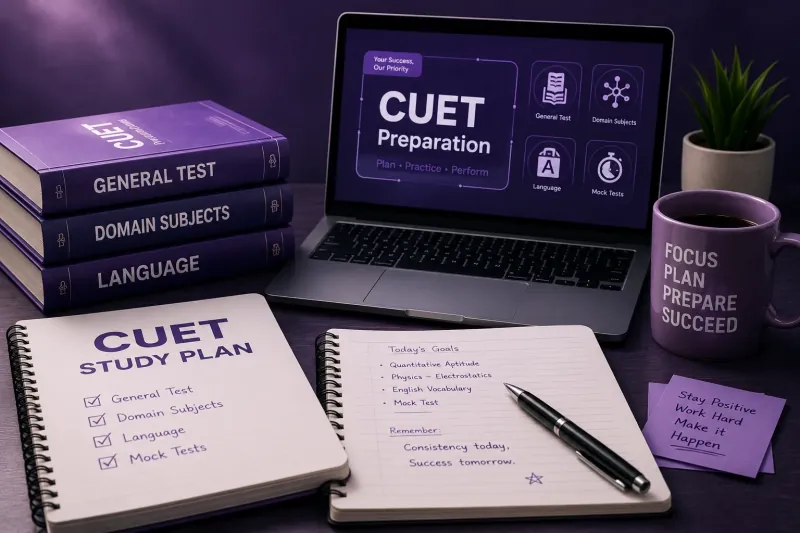
CUET UG is one of India's biggest entrance tests. More than 15.6 lakh students registered for it in 2026, and about 11.6 lakh sat at least one paper. For most of them, the hard part wasn't a new syllabus. It was answering 50 questions in an hour, accurately, in five subjects, a few weeks after board exams.
So this guide focuses on the extra work CUET needs beyond your boards: timed practice, the General Test, the language paper and mock tests. It starts with realistic hours for each stage.
As a rough guide, spend 30 to 60 minutes a day on CUET-style practice in Class 11 if you start early, 1 to 2 hours a day alongside Class 12, and 5 to 7 focused hours a day in the weeks between your last board exam and CUET. Most of your content learning happens in your board preparation. CUET hours are for speed, accuracy and the General Test.
CUET UG at a glance
NTA hadn't announced CUET UG 2027 when we checked in late September 2026, so these details come from the 2026 exam.
| What | Details |
|---|---|
| Mode | Computer-based test only, since 2025 |
| 2026 dates | 11 to 31 May, with extra sessions on 6 and 7 June. Registration ran through January 2026, and results came out on 23 June |
| Subjects | 37 in total: 13 languages, 23 domain subjects and the General Aptitude Test. You can choose up to five |
| Each test | 60 minutes, with all questions compulsory |
| Subject choice | Since 2025, you can take a subject even if you didn't study it in Class 12 |
| Competition | 15,68,867 candidates registered for CUET UG 2026, and 11,64,098 appeared |
With 50 questions in 60 minutes, you have a little over a minute per question, and wrong answers usually carry a penalty. That's why CUET preparation is mostly about timed practice. Check the marking scheme in the 2027 information bulletin when it's released, because details can change from year to year.
How many hours a day, by stage
These are our own planning estimates. They count CUET-specific practice on top of your normal board study.
| Your stage | CUET practice a day | What the time is for |
|---|---|---|
| Class 11, starting early | 30–60 minutes | NCERT basics, a reading habit for the language paper, and a few timed questions a week |
| Class 12, alongside boards | 1–2 hours | Timed questions on the chapters you finish in school, plus General Test practice |
| After boards, before CUET | 5–7 hours | Full mock tests, their review, revision of weak chapters and speed work |
| Short preparation of 6 to 8 weeks | 4–6 hours | Past papers, high-weight chapters and a mock every few days |
The gap between the end of board exams and CUET is usually only five or six weeks. It's the most useful stretch of the whole preparation, and also the easiest to waste on rest days that turn into rest weeks. Plan it before your boards start.
Use your board preparation, don't repeat it
CUET's domain subjects, like Physics, Accountancy or History, are largely based on the Class 12 NCERT syllabus. If you're studying for boards properly, you're already covering most of the content. Don't build a separate CUET syllabus. Instead, after you finish a chapter for school, do 20 to 30 timed questions on it that week. That way, one set of hours serves both exams.
The CBSE boards syllabus tracker helps here, because you can see which chapters you've finished for boards and which ones still need CUET-style practice. For how many board hours to plan, see our guide to Class 12 study hours.
What matters more than the total
1. Timed practice is the real work
Knowing a chapter well enough for a board answer isn't the same as answering 50 questions on it in an hour. Practise in timed sets from early on, and treat each set as a small test: time it, mark it, and note why you lost each mark.
2. Choose your subjects from your target courses
Each university sets its own subject requirements for each course. Before you register, look up the exact requirements for the two or three courses you want most, and make sure your five choices cover them. Picking a subject just because it seems easy can leave you without a valid combination.
3. Don't leave the General Test until the end
The General Aptitude Test is the one paper your boards don't prepare you for. It covers general knowledge and current affairs, numerical ability, reasoning and general mental ability. If you're taking it, give it 20 to 30 minutes on most days from Class 12 onward, rather than cramming it in May.
4. Practise the language paper like reading, not grammar
The language test is mostly about reading comprehension and vocabulary. Reading a newspaper editorial or a long article a few times a week, and answering questions on it, helps more than grammar drills alone.
5. Mock tests, then analysis
From the end of your boards, take a full set of papers under exam timing every few days. Spend at least as long reviewing a mock as taking it. The review tells you which chapters to revise and whether you're guessing too much. Research on learning backs this up: practice testing is one of the two most effective study techniques in a major 2013 review, as long as you learn from the mistakes.
Find out how many CUET hours you're really putting in
Log your practice by subject, keep a daily streak, and see whether the General Test is getting its share. It runs in your browser.
Track Your CUET Hours Free →Sample daily plans
Alongside Class 12 (about 1 to 2 hours of CUET practice)
- Board study as usual: this is your CUET content too, so it does double duty.
- 45 to 60 minutes: timed questions on the chapters you studied this week.
- 20 to 30 minutes: General Test practice, such as current affairs and a few reasoning sets.
- Weekend: one timed practice paper in a single subject, with a review.
After boards (about 5 to 7 hours)
- Morning (2 to 3 hours): full papers in two or three of your subjects, under exam timing.
- Midday (1.5 to 2 hours): a proper review of every wrong or guessed answer.
- Evening (2 hours): revision of the weak chapters the mock showed up, plus General Test or language practice.
Short, timed blocks work well for this kind of practice. Our guide to the Pomodoro Technique explains how to choose a block length.
A month-by-month plan for 2027
If CUET UG 2027 follows the 2026 pattern, registration will open around January and the exam will be in May. One way to plan it:
- October to January: board preparation, with timed questions on each chapter you finish, and General Test practice most days. Register as soon as the form opens, with your subject choices checked against your target courses.
- February to early April: board exams come first. Keep CUET to short practice on the days between papers.
- After your last board exam until CUET: the full 5 to 7 hour days, with mocks every few days and revision of weak chapters.
Mistakes that waste CUET hours
- Treating CUET as a separate syllabus. For domain subjects, it's mostly your board content.
- Only reading, never practising under time. Reading builds knowledge. Timed questions build the exam skill.
- Leaving the General Test until the last week. It's the paper boards don't cover.
- Guessing wildly. Where wrong answers are penalised, careless guesses cost marks.
- Choosing subjects that don't match your courses. Check the requirements before you register.
Track your CUET hours
Between boards and CUET, it's easy to lose track of how much real practice you're doing. Start a timer when you begin a timed set or a mock, and stop it when you drift. After a week you'll see whether each subject, and the General Test, is getting enough time.
That's what our free online study timer is for. It logs focused time by subject, keeps a daily streak and shows your week on a heatmap. You can also keep your CUET subjects in a custom syllabus tracker, and read our guide to the best study techniques for making practice stick.
Frequently asked questions
How many hours should you study daily for CUET?
As a rough guide, 1 to 2 hours a day of CUET practice alongside Class 12, on top of normal board study, and 5 to 7 focused hours a day in the weeks between your last board exam and CUET. Starting in Class 11 with 30 to 60 minutes a day makes the final weeks easier.
Is 2 months enough to prepare for CUET?
Often, yes, if you've studied your board syllabus well, because CUET domain subjects are largely based on it. Use the time for timed practice, full mock tests with proper review, and daily General Test practice if you're taking that paper.
Can I prepare for CUET along with board exams?
Yes, and it's the most efficient way. Study each chapter properly for boards, then do timed CUET-style questions on it the same week. Keep CUET to short practice during board exams, and switch to full CUET days once your last paper is over.
How many subjects can I take in CUET UG?
Up to five, chosen from 13 languages, 23 domain subjects and the General Aptitude Test. Since 2025 you can choose a subject even if you did not study it in Class 12, but check each university's requirements for your course before you decide.
When is CUET UG 2027?
NTA had not announced the dates when we last checked in September 2026. In 2026, registration ran through January and the exam was held from 11 to 31 May, with extra sessions on 6 and 7 June, so 2027 is likely to follow a similar timeline.
Let your board preparation cover the content, then add timed practice on each chapter as you finish it. Start the General Test early, choose subjects from your target courses, and plan the weeks after boards in advance. Take mocks, review them properly, and track your real practice hours.
Sources we checked in September 2026: The Hindu on the CUET UG 2026 results, Times of India on CUET UG 2026 registrations and subjects, Indian Express on the 2025 changes to CUET UG, Times of India on the UGC's changes for 2025, the CUET UG website, and Dunlosky et al., Improving Students' Learning With Effective Learning Techniques (2013). Hour ranges are our own planning estimates, and research findings are paraphrased.