How Many Hours Should You Study for Class 10 Boards?
Class 10 boards reward steady work far more than long days. Here's a realistic number of hours for each part of the year, how the new two-exam system works, where the marks come from, and timetables you can actually keep up alongside school.
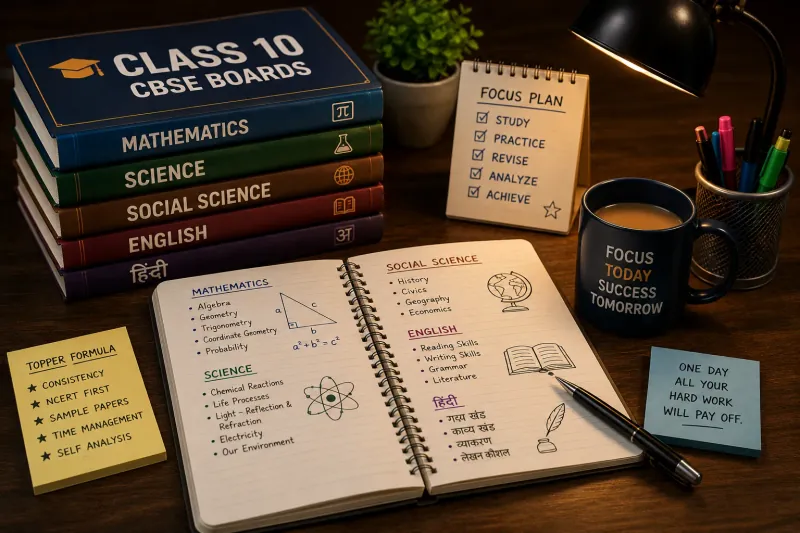
For most students, Class 10 is the first time an exam feels like it really counts, and the advice comes from everywhere: parents, tuition teachers, older cousins. Much of it is about hours. But the students who do well in Class 10 rarely study the longest. They keep up with school, revise a little every day, and practise with the kind of questions the board actually sets.
This guide gives you realistic hours for each part of the year, explains the two-exam system, shows where the marks come from, and ends with timetables you can use from tomorrow.
As a rough guide, 2 to 3 focused hours of self-study on school days is enough for most of the year, rising to 3 to 4 in January and February and 5 to 6 on study-leave days. What makes the difference is revising each chapter soon after you learn it, and practising with CBSE's sample papers well before the exams.
How Class 10 boards work now
From 2026, CBSE holds two board exams for Class 10. The first, in February, is compulsory for everyone. The second, in May, is optional. It lets students try to improve their marks in up to three subjects from Science, Mathematics, Social Science and the languages. In 2026 the main exams began on 17 February and the second exam ran from 15 to 21 May. The 2027 dates hadn't been released when we checked.
Treat February as your real exam. The May exam is a safety net for a subject that went badly, not a reason to prepare less the first time. It also falls when many students are starting Class 11, so a second attempt costs you time you'd rather spend elsewhere.
Where the marks come from
Each main subject is out of 100: 80 marks for the board paper and 20 for internal assessment done in school. You need at least 33 percent in each subject to pass. Here's how the 80 board marks are split by unit in the three biggest subjects, according to the CBSE curriculum for 2026-27.
| Subject | Units and board marks |
|---|---|
| Mathematics (Standard or Basic) | Algebra 20, Geometry 15, Trigonometry 12, Statistics and Probability 11, Mensuration 10, Number Systems 6, Coordinate Geometry 6 |
| Science | Chemical Substances 25, World of Living 25, Effects of Current 13, Natural Phenomena 12, Natural Resources 5 |
| Social Science | History 20, Geography 20, Political Science 20, Economics 20 |
This tells you where hours pay off. In Maths, Algebra alone is a quarter of the paper. In Science, chemistry and biology together carry more than half. In Social Science, the four parts are equal, so none can be skipped. The CBSE boards syllabus tracker lists every chapter, so you can tick them off as you learn and revise them.
How many hours a day, by stage of the year
These are our own planning estimates. They're self-study hours, on top of school and any tuition.
| When | School days | Weekends and holidays | What the time is for |
|---|---|---|---|
| October to December | 2–3 focused hours | 4–5 hours | Keeping up with school, same-day revision, finishing the syllabus |
| January and pre-boards | 3–4 hours | 5–6 hours | Full revision and timed sample papers |
| Study leave and gaps between papers | 5–6 hours | Revising the next paper and practising past questions | |
Resist the urge to jump straight to eight hours a day in January. Long days usually mean more time at the desk, not more learning, and they leave you tired for school the next morning.
What matters more than the total
1. NCERT first
Board papers are built on the NCERT textbooks. Read each chapter properly, including examples, diagrams and in-text questions, and do the exercises at the end before you open any other book.
2. Revise on the same day
Spend 15 to 20 minutes each evening going over what you learned in school, with the book closed first. Then check what you missed. It feels slower than reading ahead, but you forget far less. Memory research consistently finds that testing yourself and spreading revision over time beat rereading.
3. Practise the question types the board uses
CBSE papers include competency-based questions, such as case-based and source-based questions, that test whether you can apply what you've learned, not just repeat it. Practise them from the start of the year, not just in February.
4. Use CBSE's sample papers and marking schemes
CBSE publishes sample question papers and marking schemes on its academic website. The marking schemes show exactly what earns full marks: the steps in a Maths answer, the key terms in Science, the points in a Social Science answer. Use them from December onward, and time yourself on full papers in January.
5. Don't ignore the 20 internal marks
Internal assessment is a fifth of each subject. Keep your notebooks, projects and practical records up to date through the year. They're some of the easiest marks you'll get.
Find out how focused your board prep really is
Log your study time by subject, keep a daily streak, and see whether Maths, Science and Social Science are each getting their share. It runs in your browser.
Track Your Class 10 Hours Free →Sample daily timetables
A normal school day (about 2 to 3 hours)
- After a break (60 minutes): Maths practice on the chapter your class is doing.
- Evening (60 minutes): Science or Social Science, alternating each day.
- Before bed (20 to 30 minutes): same-day revision of what you learned in school, book closed first.
A weekend or holiday (about 4 to 5 hours)
- Morning (2 hours): your weakest subject, in two blocks with a break.
- Afternoon (1.5 hours): a second subject, including a few sample-paper questions.
- Evening (1 hour): languages, or revision of an older chapter.
Study leave (about 5 to 6 hours)
- Morning (2.5 hours): one full sample paper for the next exam, timed.
- Afternoon (1.5 hours): check it against the marking scheme and fix the mistakes.
- Evening (1.5 hours): revise the chapters the paper showed you were weak in.
Short blocks with real breaks work well at this age. Our guide to the Pomodoro Technique explains how to set them up.
Mistakes that waste Class 10 hours
- Reading chapters again and again instead of testing yourself. Rereading feels productive, but it doesn't show you what you've forgotten.
- Leaving sample papers to the last two weeks. By then there's no time to fix what they reveal.
- Skipping the diagrams and maps. They carry marks and are easy to practise.
- Relying on the May exam. Prepare to do your best in February.
- Cutting sleep before exams. A rested brain recalls more and makes fewer careless mistakes.
Track your real hours
It's easy to think you studied for three hours when it was really one and a half, with the phone in reach. Start a timer when you begin working and stop it when you drift. After a week you'll know your real number, and which subject is getting skipped.
That's what our free online study timer is for. It logs focused time by subject, keeps a daily streak and shows your week on a heatmap. For the next step after Class 10, see our guide to Class 12 study hours, and for methods that make revision stick, read about the best study techniques.
Frequently asked questions
How many hours should I study daily for Class 10 boards?
As a rough guide, 2 to 3 focused hours on school days for most of the year, 3 to 4 in January and February, and 5 to 6 on study-leave days. Revising each chapter soon after you learn it matters more than the exact number.
Is 3 hours of study enough for Class 10?
For most students, yes, if those three hours are focused, include same-day revision, and are kept up through the year. Add timed sample papers from December onward and a few longer days in the final weeks.
Will there be two board exams for Class 10 in 2027?
Yes, under the scheme CBSE introduced for 2026. The first exam in February is compulsory, and the second in May is optional, for improving marks in up to three subjects from Science, Mathematics, Social Science and the languages. Check the official 2027 dates when CBSE releases them.
Is NCERT enough for Class 10 boards?
For most subjects, NCERT covers what the board paper tests, so read it thoroughly and do every exercise. Add CBSE sample papers and past papers for practice with the question types, especially competency-based and case-based questions.
How many marks are internal in Class 10?
In the main subjects, 20 of the 100 marks come from internal assessment in school, and 80 from the board paper. Keeping notebooks, projects and practical records up to date is an easy way to secure those marks.
Study a steady 2 to 3 hours on school days, revise every chapter soon after you learn it, and start CBSE's sample papers by December. Put more time into the units that carry the most marks, secure your internal marks, and prepare to do your best in February rather than counting on the May exam.
Sources we checked in September 2026: the CBSE curriculum for 2026-27, including the Mathematics and Science syllabus documents, CBSE's notification on two board examinations for Class 10, Times of India on the 2026 board exam rules, Economic Times on the 2026 second exam dates, and Dunlosky et al., Improving Students' Learning With Effective Learning Techniques (2013). Hour ranges are our own planning estimates, and research findings are paraphrased.